QSR vs Casual Dining vs Fine Dining: Which Fits You?
2026-07-08
7 Mins Read
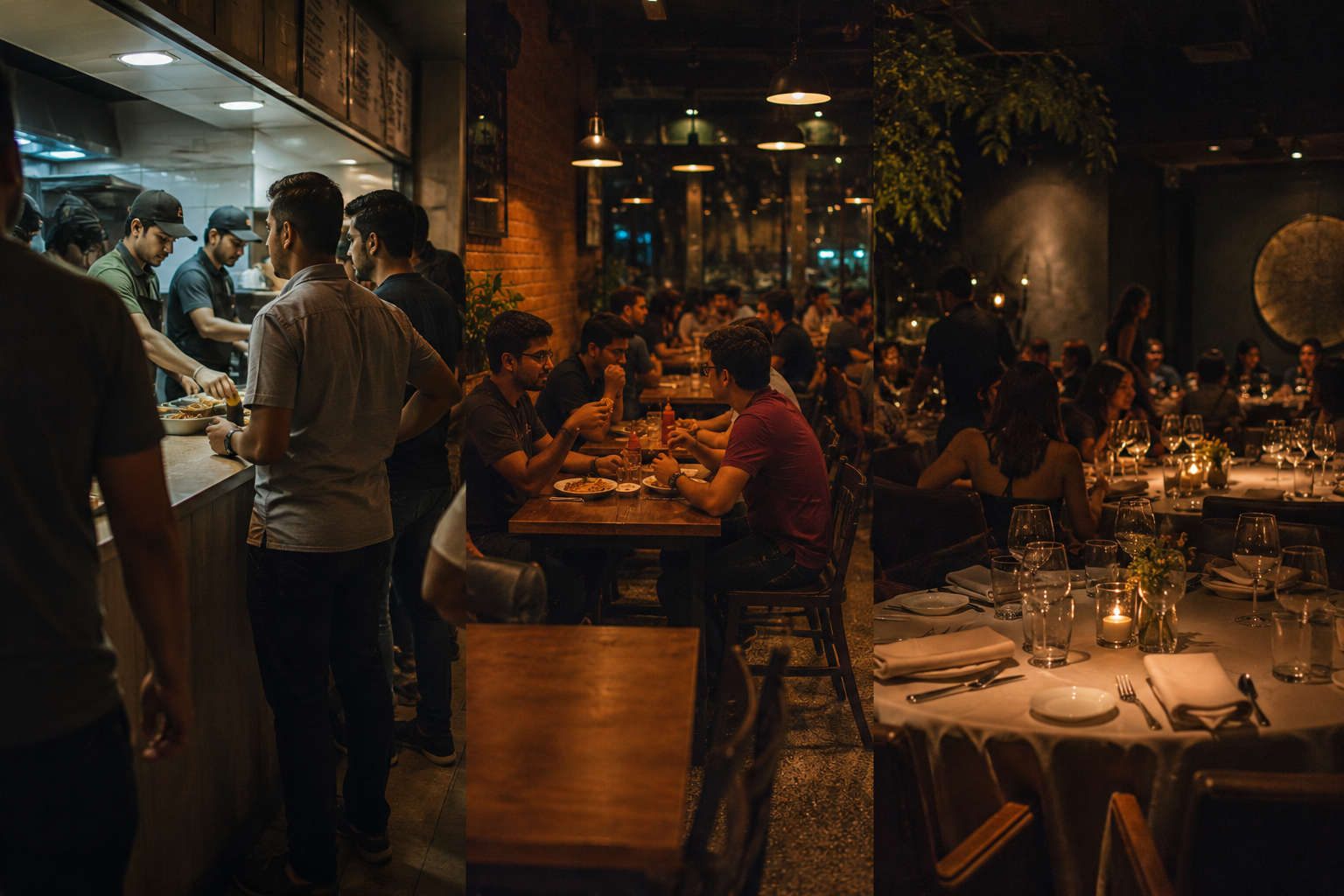
The format is a decision, not a label
Most first-time owners pick their restaurant format with their heart. They picture a beautiful fine-dining room with white tablecloths, so they build one. Here is the uncomfortable truth we tell every client: your format is not a branding choice - it is an economic identity you are locked into from the first cheque.
QSR, casual dining and fine dining are not three flavours of the same business. They have different customers, different margins, different cash needs, and wildly different odds of ever becoming a chain. Choose the wrong one for your goal and no amount of good food will save the P&L.
Across 11+ years and 550+ F&B projects, we have built and fixed all three. This is the honest comparison - what each format actually is, what it costs, and how to choose the one that fits your money and your ambition, not just your daydream.
What actually separates QSR, casual dining and fine dining?
The three formats differ on one core axis: are you selling speed, comfort, or experience? Everything else - price, size, staffing, scalability - flows from that single answer.
1. QSR (Quick Service Restaurant) sells speed and consistency. Limited menu, fast service, often counter or delivery-led, low-to-mid ticket. The product is repeatable; the whole model is built to scale.
2. Casual dining sells comfort and value. Full table service, a broader menu, a relaxed sit-down experience at a mid ticket. It lives between grab-and-go and occasion dining.
3. Fine dining sells experience and craft. Premium ambience, skilled chefs, elaborate menus, high ticket, often a bar. You are selling an evening, not a meal.
A café or a cloud kitchen sits adjacent to these - a café is casual-dining-lite built around beverages, a cloud kitchen is a QSR with no dine-in. But the three above are the real fork in the road.
The side-by-side comparison
Here is how the three formats compare on the dimensions that decide whether you make money. The investment and footprint figures are DNY's internal planning benchmarks for the Indian market - they vary by city and concept, but they show the relative scale of each commitment.
| What to weigh | QSR | Casual Dining | Fine Dining |
|---|---|---|---|
| Core promise | Speed + consistency | Comfort + value | Experience + craft |
| Typical ticket (AOV) | Low | Medium | High |
| Footprint (DNY ref) | 80 - 1,500 sq ft | 1,000 - 1,500 sq ft | 1,500 - 2,000+ sq ft |
| Setup investment | ₹5L (kiosk) - ₹55L (large) | ₹40 - 50L | ₹60 - 75L+ |
| Segment | Massy to Mid | Mid | Mid to Premium |
| Revenue engine | Volume + delivery | Dine-in footfall + some delivery | Occasion + high ticket + bar |
| Staff-skill dependency | Low to moderate (systemisable) | Moderate | High (chef + service craft) |
| Menu | Tight, standardised | Broader, still disciplined | Wide, seasonal, à la carte |
| Scalability / franchise-fit | Highest | Moderate | Lowest (craft-bound) |
| Biggest risk | Thin margins - needs volume | "Stuck in the middle" positioning | High fixed cost + founder/chef dependency |
Read that table as a set of trade-offs, not a ranking. There is no best format - only the right one for your capital, your location and your appetite for scale.
QSR: built to scale, unforgiving on margin
QSR is the format to choose if your ambition is a chain. Its whole design - tight menu, small footprint, standardised process - is what makes it replicable across dozens of outlets. India's QSR market is also the fastest-growing restaurant segment, heading toward roughly USD 47 billion by 2031, which is why most new-age capital flows here.
The catch: QSR margins are thin per plate, so the model only works at volume and with ruthless cost discipline. Profit is won on unit economics, not vibe.
This is where a lot of our work lives. When we built the franchise model and central-kitchen SOPs for Yewale Amruttulya, the tea QSR now running 700+ outlets, the systems underneath were the real product - not the tea. And when we took Arabian Bites in Pune from 3 to 7+ outlets, adding a central kitchen and moving it from near-zero SOPs to fully process-driven. QSR rewards the operator who treats the outlet as a system to be copied, not a shop to be run.
Casual dining: the most flexible - and the easiest to blur
Casual dining is the sweet spot for many Indian entrepreneurs: broad appeal, family-friendly, higher ticket than QSR without the fixed cost of fine dining. It is forgiving on ambience and generous on menu range.
That flexibility is also its trap. The single biggest killer of casual-dining restaurants is fuzzy positioning - trying to be everything to everyone, ending up memorable to no one. A casual diner needs a sharp reason to exist and a menu engineered so every dish earns its place, or it drifts into the crowded middle.
We see both sides of this. On the build side, we helped shape Harley's Fine Baking into a 21+ outlet, Guinness World Record-holding brand through positioning, branding direction and scalability systems. On the fix side, Kandoori, a multicuisine restaurant in Sri Lanka, came to us leaking cost across sales and purchases; in nine months we plugged the leakage, rebuilt recipes, derived a hero product and turned it into a profit centre. Casual dining lives or dies on discipline behind a relaxed front.
Fine dining: prestige on the menu, pressure on the P&L
Fine dining is the format people romanticise most and understand least. Yes, the ticket is high and the brand can be prestigious. But it carries the heaviest fixed costs - large footprint, expensive interiors, skilled culinary and service teams, a bar programme - and the lowest ability to scale, because the experience is bound to a specific chef, room and city.
Fine dining is a craft business. It can be wonderfully profitable, but it rarely franchises cleanly, and it is the most dependent on the founder and head chef being present. That founder-dependency is exactly the risk that must be designed out early.
It is also where execution detail decides everything - front-of-house service, upselling, beverage and bar economics, guest experience. Our resto-bar and fine-dining consulting is built around precisely that: FOH training for captains and stewards, service and upselling standards, bar and mixology planning, and the systems that let a premium room run consistently. In fine dining, the strategy is only half the job; the floor is the other half.
So which format should you actually choose?
Choose the format that matches your capital, your location and - most of all - your end goal. Work backwards from the ambition, not forwards from the fantasy:
1. You want to build a chain / attract investors → QSR. It is the only one of the three engineered to replicate, and the segment capital is chasing.
2. You want a strong single unit or a small local group with broad appeal → casual dining. Just commit to one sharp positioning and a disciplined menu.
3. You want to express a culinary vision and own a premium niche → fine dining. Go in knowing it is a craft business with high fixed costs and limited franchise-ability.
And whichever you pick, the same money rule applies: hold roughly 11 months of running capital before you open. Most food businesses take 6-12 months to break even, and the ones that die usually die of cash, not concept - regardless of format.
Why this matters for your restaurant
The format decision is the highest-leverage choice you will make, because it is the hardest to reverse. A wrong menu can be re-engineered. A wrong location can sometimes be exited. But a fine-dining build-out cannot become a QSR without starting over - and a QSR margin structure cannot suddenly carry fine-dining overheads. Profit really is decided on the drawing board.
That is what we do at DNY Hospitality. We help you pressure-test the format against real market data before you commit, then build it properly - concept, menu engineering, kitchen design, SOPs - scale it into a franchise-ready system if that is the goal, and sustain it if it is already open but leaking margin. We have done it across all three formats and 8 countries, from QSR chains to premium cafés to multicuisine turnarounds. If you are still deciding which format fits - or you suspect you picked the wrong one - talk to us before the build, not after.
Share


Related Blogs

Importance of Restaurant Branding in India & Its Direct Impact on Revenue!
Importance of Restaurant branding in India is taking giant strides. The direction of the food & beverage industry is opening gates to new opportunities.
Kulcha Patola: How a Street Food Became a Scalable QSR Brand
Can a traditional Amritsari kulcha become a viral QSR product? Discover how DNY Hospitality turned a street-style comfort food into a multi-outlet franchise in Punjab with Patakha Pockets and a hub-and-spoke strategy.
KOGO: How We Transformed a Korean–Japanese QSR for Scalable Success
What started as a vision for authentic Korean flavors in Thane became a scalable QSR model with central kitchen systems, a refined menu, and a strong brand identity — built entirely by DNY Hospitality.