How Much Does Restaurant Consulting Cost in India?
2026-08-24
8–10 Minutes Mins Read
How Much Does Restaurant Consulting Cost in India?
Introduction
If you are planning to open a restaurant, improve an existing outlet or expand into multiple locations, one of the first questions you will probably ask is: How much does restaurant consulting cost in India?
There is no single answer. Restaurant consulting is not a standard product with one fixed price. The investment depends on what the restaurant needs, where the business is in its journey, how complex the project is and how deeply the consulting team is expected to be involved.
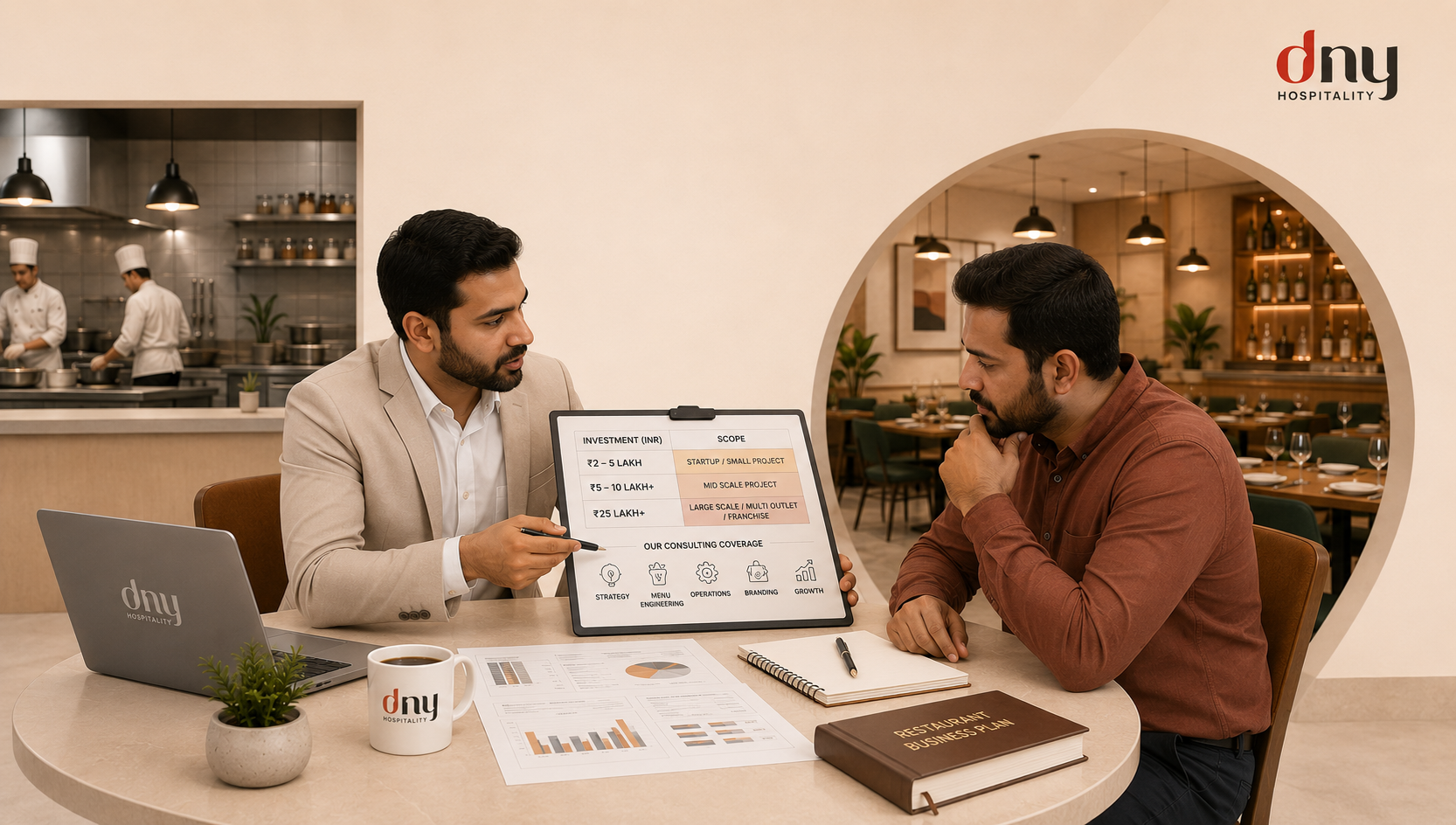
For example, a small café starting from scratch may require a consulting investment around ₹2–5 lakh, depending on the scope. A more involved restaurant project may require ₹5–10 lakh or more, while larger multi-outlet, franchise, turnaround or complex consulting engagements can reach ₹25 lakh+ depending on the work involved.
These are broad planning ranges, not fixed prices. The actual consulting fee should be determined after understanding the restaurant, its requirements, budget and expected deliverables.
A new café preparing to open its first outlet may need feasibility research, business modelling, menu engineering, kitchen planning, SOPs, hiring and launch support. An established QSR with declining profitability may instead need an operational audit, P&L review, menu and margin analysis, manpower review and a corrective programme.
A restaurant brand preparing to franchise may require financial modelling, unit economics, franchise modelling and systems that can be replicated across locations. These are very different consulting assignments.
This is why restaurant owners should look at scope, deliverables, budget and expected business outcomes, rather than choosing a consultant based only on the lowest quotation.
Why There Is No Fixed Restaurant Consulting Fee in India
The cost of restaurant consulting changes because every food business has different requirements. A startup may need support from the idea stage through its first year of operations, while an existing restaurant may only need help solving a specific operational problem.
A growing chain can have an entirely different requirement, with consulting covering systems, financial performance, franchising and expansion.
The DNY Hospitality model reflects these differences. Its consulting work is organised around different business situations, including startups, running-business turnarounds, joint ventures, concept restaurants and international brands entering India.
For example, startup consulting can cover the journey from pre-launch through first-year handholding, while turnaround work can be scoped after an operational and P&L audit.
So asking only, “What is your consulting fee?” does not give enough information to compare two proposals fairly.
The better question is: “What exactly does my restaurant need, what is my budget, and what should the consultant deliver within that scope?”
What Determines Restaurant Consulting Cost?
The first major factor is the stage of your restaurant. A restaurant that has not opened yet usually needs a different type of consulting from a restaurant that has been operating for several years.
Startup consulting can involve feasibility and competitor studies, business positioning, go-to-market strategy, business and financial modelling, menu engineering, recipe standardisation, kitchen and equipment planning, SOP development, manpower planning, POS implementation, training and launch governance.
An existing restaurant may instead require an operational audit, P&L and cost-structure review, menu and margin analysis, manpower and productivity review, guest experience assessment, vendor correction, process improvement and staff retraining.
The second factor is the scope of consulting. Asking a consultant to review one menu is very different from asking them to build an entire restaurant business from scratch.
A comprehensive startup engagement may involve strategy, financial modelling, menu and product development, kitchen planning, systems, people, procurement, brand, marketing and launch support. DNY describes its startup scope as “scratch to scale”, covering areas such as feasibility, business modelling, financial modelling, menu engineering, recipe standardisation, SOPs, POS logic, manpower planning, franchise modelling and investor readiness.
The third factor is restaurant size and complexity. A small independent café and a multi-outlet QSR should not be expected to have the same consulting requirements. Complexity can increase when a project involves multiple outlets, large kitchen operations, multiple revenue channels, franchise planning, investors, international market entry, complex procurement or large teams.
The fourth factor is how long the consultant remains involved. Some restaurant owners need a defined project with specific deliverables, while others need continuing support while the business is being implemented and stabilised.
The fifth factor is whether the consultant only advises or also helps implement. There is a major difference between receiving a report containing recommendations and having a consulting team involved in building the operating system.
Implementation can include SOP development, POS logic, manpower planning, training, procurement coordination, vendor onboarding, menu implementation, launch governance and performance reviews.
What Are the Common Restaurant Consulting Pricing Models?
There is no single pricing structure that works for every consulting project. Depending on the engagement, restaurant consultants may work through a defined project scope, an ongoing consulting arrangement or another commercial structure agreed between the business and consulting team.
A restaurant startup may require a project covering concept development through launch. An existing restaurant may need an operational diagnostic followed by a corrective programme. A growing brand may require continuing support around expansion and governance.
DNY Hospitality follows a scope-first approach rather than publishing one universal restaurant consulting price. The engagement is shaped around the restaurant's format, stage and requirements, followed by a written scope containing deliverables, phases, timelines and commercials.
This makes it easier for the restaurant owner to understand what they are actually paying for rather than comparing two consulting fees without understanding the difference in scope.
How Much Should You Expect to Pay for Restaurant Consulting?
As a broad planning reference, a smaller and more focused restaurant consulting engagement could start around ₹2–5 lakh. A more involved restaurant project may fall around ₹5–10 lakh or more, depending on the number of services, duration and implementation requirements.
For larger restaurants, multi-outlet businesses, franchise programmes, turnarounds or complex consulting assignments, the investment can reach ₹25 lakh+ depending on the scope and level of involvement.
These figures are not fixed DNY Hospitality prices or universal industry rates. They are broad examples showing how consulting investment can change according to the work involved.
The important point is that a restaurant owner should not feel that consulting has to fit into one standard package.
For example, if your budget is ₹3 lakh, the right approach is to understand what can realistically be achieved within that investment rather than adding unnecessary services simply to make the project bigger.
Similarly, if the restaurant has a larger budget and requires end-to-end support, the consulting scope can be designed around the level of work required to achieve the business objective.
The objective should always be to match the budget with the right scope of work and focus the investment on the areas that can create the greatest business impact.
What Should Be Included in a Restaurant Consulting Proposal?
Before agreeing to a consulting fee, restaurant owners should ask for a written scope that clearly explains what the consultant will actually do.
Depending on the project, this can include business and strategy work such as market feasibility, competitor study, business positioning, go-to-market strategy, business modelling and financial modelling.
It can also include menu and product development covering menu engineering, recipe development, recipe standardisation, costing, yield control and new product development.
Operational consulting may cover SOPs, operating processes, POS logic, manpower planning, KRAs, KPIs and operations training.
For restaurants preparing to launch or expand, the scope may also include procurement, vendor coordination, hiring, opening governance, local-store marketing, performance reviews, franchise modelling and expansion planning.
A good proposal should make it clear what is included, what is not included, how long the project will take and what the restaurant owner can expect at the end.
Why the Cheapest Restaurant Consultant May Not Be the Best Choice
Price matters, particularly when a restaurant is already working within a limited investment budget. But consulting should not be treated like buying the cheapest piece of equipment.
A low quotation may look attractive until you discover that the consultant is only providing recommendations, has limited hospitality experience or does not remain involved during implementation.
The opposite is also true. A higher fee does not automatically mean better consulting.
The better comparison is scope, expertise, implementation, accountability and expected business impact.
Restaurant owners should ask whether the consultant understands their restaurant format, whether the actual business will be analysed, what deliverables will be provided, who will implement the recommendations and how success will be measured.
The right consultant should also be willing to understand the owner's budget and recommend a realistic scope rather than pushing unnecessary services.
Is Restaurant Consulting Worth the Investment?
Whether consulting is worth the investment depends on the restaurant and the problem being solved.
A useful way to evaluate it is to consider what avoidable mistakes could cost the business.
A poorly planned kitchen can affect productivity every day. An incorrectly priced menu can reduce margins on every order. Poor purchasing can continuously increase costs, while weak inventory control can create recurring wastage.
Poor manpower planning can increase labour costs, and weak SOPs can create inconsistency across shifts and outlets. A weak financial model can also result in significant investment in a concept that was not commercially viable in the first place.
The purpose of consulting is to identify and address these issues before they become larger problems.
The best consulting engagement is not necessarily the most expensive one. It is the one where the scope matches the restaurant's actual needs and budget, while still providing enough expertise and implementation to create meaningful results.
What Does DNY Hospitality's Consulting Process Look Like?
DNY Hospitality's consulting approach follows six stages: Discover, Define, Design, Build, Launch, and Govern & Scale.
The Discover stage focuses on feasibility, market and competitor study, site and catchment analysis, or an operational and P&L audit for an existing business. The purpose is to create a clear diagnostic before moving forward.
The Define stage focuses on positioning, business model, format, financial model and the potential return on investment. This creates the commercial foundation for the project.
The Design stage covers menu engineering, recipes, brand identity, interiors and packaging around the commercial model. The objective is to make sure the customer-facing concept and business model work together.
The Build stage turns the strategy into an operating system. This can include SOPs, POS logic, manpower planning, KRAs, procurement, vendor onboarding, hiring and training.
The Launch stage focuses on opening governance, local-store marketing and live correction during the early weeks of operation.
The final Govern & Scale stage can include monthly handholding, KPI reviews, franchise modelling, investor readiness and expansion planning. The objective is to create a business that can eventually be handed over, franchised or funded.
How DNY Hospitality Approaches Consulting Fees
DNY Hospitality's approach is to understand the restaurant before deciding what level of consulting is actually required.
The team can look at the restaurant's format, stage, business goals, challenges and available budget before defining the appropriate scope.
This means a restaurant owner does not necessarily need to purchase every possible consulting service. The work can be prioritised around the areas that matter most to the business.
For example, a small startup may need a focused scope covering concept, financial planning, menu, kitchen and launch preparation. A larger existing restaurant may require a broader operational turnaround, financial review, staff training and ongoing performance management.
The purpose is to create a consulting scope that is appropriate for the business and its budget, while still providing the expertise needed to achieve the desired outcome.
How to Compare Restaurant Consultants Before Hiring One
Before choosing a consultant, look at whether they understand your restaurant format and whether they have relevant hospitality experience.
Consider whether they understand the financial side of the restaurant as well as the operational side. Restaurant consulting should connect strategy with actual business performance.
It is also important to understand whether the consultant provides implementation support or simply gives recommendations. Ask for a written scope and make sure the deliverables, timelines and responsibilities are clear.
Most importantly, discuss your budget openly.
A professional consultant should be able to understand what you are trying to achieve, assess the available investment and help determine what work should be prioritised within that budget.
The goal should not be to spend the maximum amount.
The goal should be to make the right investment for the right work and achieve the strongest possible business result.
Conclusion
So, how much does restaurant consulting cost in India?
There is no single price that accurately represents every restaurant consulting project. A smaller engagement may be around ₹2–5 lakh, a more involved project may be ₹5–10 lakh+, while larger multi-outlet, franchise, turnaround or complex consulting programmes can reach ₹25 lakh+ depending on the scope.
These are broad planning ranges, not fixed DNY Hospitality prices or universal market rates. The actual investment depends on the restaurant's stage, format, size, complexity, scope, duration, budget and level of implementation required.
A startup building its first restaurant will have very different consulting requirements from an established restaurant undergoing a turnaround or a brand preparing for franchise expansion.
The smarter approach is therefore not to search for the cheapest consultant. Start by defining the problem, understanding the available budget, deciding what work is most important and then building a scope around those priorities.
At DNY Hospitality, the objective is to understand the business and work according to the restaurant's requirements and budget, rather than forcing every client into the same consulting package.
The right consulting investment is the one that puts the available budget into the areas that can create the greatest value, while providing the expertise, systems and implementation needed to produce a stronger business result.
Frequently Asked Questions
1. How much does restaurant consulting cost in India?
Restaurant consulting can vary significantly depending on the project. As a broad planning range, smaller engagements may start around ₹2–5 lakh, while more involved projects can be ₹5–10 lakh+. Large multi-outlet, franchise, turnaround or complex consulting programes can reach ₹25 lakh+ depending on the scope. These are indicative ranges, not fixed DNY Hospitality prices.
2. Can restaurant consulting fit my budget?
Yes. The consulting scope can be discussed according to the restaurant's requirements, objectives and available budget. Instead of adding unnecessary services, the work can be prioritised around the areas that are most important for the business.
3. What factors affect the cost of restaurant consulting?
The main factors include the restaurant's stage, size, format, number of outlets, project complexity, consulting scope, duration and whether the consultant provides implementation, training and ongoing support.
4. Is restaurant consulting worth the cost?
Restaurant consulting can be valuable when it helps prevent expensive mistakes, improve margins, control costs, strengthen operations and create systems for sustainable growth. The value should ultimately be judged by the business improvements created rather than the consulting fee alone.
5. What should I check before hiring a restaurant consultant?
Look at hospitality experience, relevant restaurant formats, consulting scope, implementation support, deliverables, timelines and how the consultant measures results. It is also important to discuss your budget openly and make sure the proposed work matches what your restaurant actually needs.
6. How does DNY Hospitality determine the right consulting cost for my restaurant?
DNY Hospitality first understands the restaurant's format, stage, goals, challenges and budget before defining the scope. The objective is to provide a practical consulting plan that fits the business requirements and puts the available investment toward the work that can create the strongest results. The focus is not simply on offering the cheapest or most expensive package, but on creating the right scope for the right budget and delivering meaningful business value.
Share


Related Blogs

DNY Hospitality: A Leading Restaurant Consultant
DNY Hospitality takes pride in introducing itself as one of the highly sagacious restaurant consultant in the F&B business.

25 Reasons Why You Need a Restaurant Consultant
Opting for a professional restaurant consultant in the making of your restaurant or food & beverage venture is of high value in the standardisation of your brand.

procurement and liaison
DNY Hospitality is a one-stop solution for your Restaurant consulting & Procurement & Liaison for setup. DNY liaisons with A to Z vendors for procurement of restaurant & hotel supplies.